For many, Thanksgiving is the best holiday of the year. It’s a crowded table, with familiar traditions and lots and lots of food. But for others, the day can feel complicated before they even reach the table.
Maybe you’re already thinking about the food you’ll eat (or won’t), the comments about your body that will be made, or how to navigate a holiday centered around food when food is the last thing you want to keep thinking about.
If that’s you, I want you to know you’re not alone. But I only know because I’ve been there.
It started when I was 14. The voices, but not like you might think. Ana and Ortho had an opinion on just about everything.
The calories in a piece of pumpkin pie? 323.
The amount of exercise needed to burn said calories? 55 minutes of biking, according to my height and weight.
The lies I could tell to get out of another family gathering?
I’m not hungry.
My stomach hurts.
I just got my period.
The girl I saw in the mirror staring back at me?
Never good enough.
Ugly.
Losing control.
Most people assume eating disorders are about food. For some, they are. But while I didn’t know it then, mine wasn’t about the hours of exercise, the limited food intake, or even the poor view of self. It was about control.
As a young teen, everything was changing. And by changing, I mean falling apart.
My half-siblings’ addictions constantly brought them in and out of my life. Our home became a place of verbal abuse, drug deals, and danger. My relationship with my father wasn’t what it should have been. And growing up seemed risky, unsafe, perilous. By the time my body caught up to my environment, I was scared.
While I couldn’t control what was happening around me, I knew I could control me.
I could be disciplined. Become vegan. Cut out fast food. Exercise. Eat “healthy.” Have a 4.0 G.P.A. Be the “good” kid who doesn’t mess up. Wear the best clothes. Have the right faith. Be perfect.
I’ll never become like them.
But I didn’t have to use drugs, drink, or speak harshly to be like them.
I needed an addiction.
One was just beginning—I just didn’t know it yet.
By the time I was 16, I truly believed I was healthy, in control, and taking care of my body. I started every day with ab exercises, skipping breakfast, and doing sitting stomach contractions in class. At “lunch,” I’d take a bite of my sandwich and throw the rest away. After school, I’d jog in place for three hours. Right before bed, I’d track all the calories and research what I needed to do to “earn the burn.”
Ana (Anorexia) helped me stay in control. Ortho (Orthorexia) allowed me to stay “fit.” I was convinced neither was a problem.
Until my body said otherwise.
It was the week before Thanksgiving, and normally I was ecstatic. Time to decorate the house, go Black Friday shopping, and make half a dozen pumpkin rolls. But when Thanksgiving dinner got moved to a 4 pm lunch, and I couldn’t do a workout before, I flipped.
All around me was more. More food. More desserts. More eating. More opportunities to mess up and eat “bad” food. My MyFitnessPal app even reminded me to eat a healthy and well-balanced meal to avoid sugar crashes and weight gain.
In a society obsessed with thinness, fitness, and wellness, I lost sight of what was realistically “healthy.” Because anything can become harmful when it becomes all-consuming.
What started as a way to prevent myself from growing up, control the crumbling world around me, and be “healthy” had become an unseen nightmare of compulsion, legalism, and rules. I wasn’t fit and flourishing. I was jogging in the shower, jogging in my closet, doing push-ups on my bathroom floor. I was constantly moving, constantly lying, constantly throwing away food.
This wasn’t about food. It was my coping mechanism.
And I wonder if that’s something you need to hear too. That sometimes what we’re struggling with isn’t what’s on the surface—it’s what’s used to cover what’s underneath. From food to exercise, to alcohol, drugs, scrolling, or even control, each can be our feeble attempt to cope with something beyond what we understand. When the holidays bring all of that to the surface, you don’t have to navigate this alone.
By 21, I was eating food, but still exercising compulsively. Until the day I broke my foot.
That prior summer I’d decided I was going to stop my eating disorder cold turkey (no gobble gobble pun intended) and focus on making the competitive dance team. I worked my tail off, promised God I’d stop my unhealthy habits, and worked towards a concrete goal. But when I didn’t make the team by a fraction of a point, I fell back into old ways.
The night I injured my foot, I curled into a ball on the floor of my bathroom and screamed at God, “Why did you do this?” The answer I heard was, “You know why.”
As salty tears seeped down into hollow places, I knew it was over. The seven-year battle was done. I felt God was saving me from me. Saving me from something that had become my master.
Over the next few months, the desire to count calories dissolved. I stopped comparing myself to those on social media. I deleted the fitness apps. And I refused to measure portions or look at calorie labels.
I found hobbies I enjoyed (beyond working out), and my foot slowly healed. I learned how to exercise properly and eat well. It wasn’t a simple, beautiful, or easy moment. It was hard. It hurt. I was angry and irritable a lot of days. But I learned everyone has a story and this is part of mine—it’s nothing to be ashamed of.
Today, it’s been nearly a decade since I heard Ana and Ortho call my name. But I can’t pretend the voices don’t try to come back. Because sometimes they do.
I used to think recovery meant never struggling again. Now I know it’s knowing what to do when I struggle.
About two years after I found healing from my eating disorder, I fell incredibly ill. I was diagnosed with 10+ mental and physical health issues, and honestly, I believed they were my fault. That I was being punished and that it was what I deserved. When I could eat food, I didn’t. Now that I could, everything made me sick.
I’ve since learned that’s not true; that’s not how the God I know and love works. And there’s a difference between an eating disorder telling you that you can’t eat something and your body telling you: Hey, I don’t tolerate this well. But I’m still learning, still growing.
I’m better. I eat food. I don’t over-exercise, count calories, or categorize food as “good” or “bad.” But I’m also not going to claim perfection. Healing can be an ongoing refinement.
As Thanksgiving approaches, you might be wondering how you’ll get through this. The meal, the comments, the memories. Maybe you’re already anxious about finding a seat at the table and eating the food that’s placed in front of you.
I don’t know where you are in your struggle today, but I want you to know that healing is possible.
If there’s one thing I could tell younger me, it would be: don’t wait to ask for help. I know it’s frightening, and hard, and scares the crap out of you. But waiting to seek help is worse.
Don’t hurt yourself trying to become something society has convinced you is “healthy.”
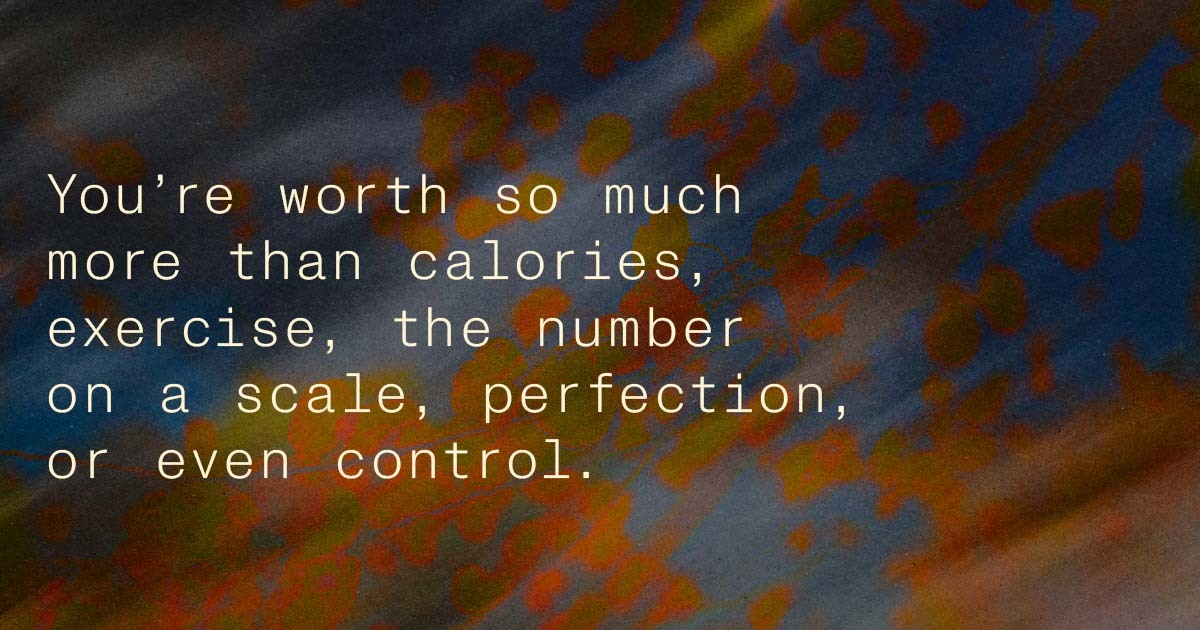
You’re worth so much more than calories, exercise, the number on a scale, perfection, or even control.
If you’re someone who knows someone who is struggling, please don’t just tell them to “stop,” “eat more,” or threaten to hospitalize them. Instead, ask questions and listen. Don’t judge. Look underneath the food. Pay attention to how you speak to yourself, your body, your habits. Show what a healthy relationship with food and exercise looks like. Offer compassion.
Thanksgiving is just a few days away. The holidays can still be complicated. But if you’re struggling, please know it’s okay. You don’t have to carry this alone.
Ask someone to sit with you.
Take a small step.
Take a deep breath.
Chew a small bite.
And then another.
One small step, breathe, bite at a time; you will make it through this.
You are more than a number on a scale or a measuring tape. You are human. Messy and whole, capable of so many good things, regardless of your body’s shape. We encourage you to use TWLOHA’s FIND HELP Tool to locate professional help and to read more stories like this one here. If you reside outside of the US, please browse our growing International Resources database. You can also text TWLOHA to 741741 to be connected for free, 24/7, to a trained Crisis Text Line counselor. If it’s encouragement or a listening ear that you need, email our team at [email protected].