Some two years ago, I wrote about empowerment and having agency over one’s mental health. That is, when someone with a mood disorder says they aren’t feeling well, ask them what they need and how they want to be helped.
This year is my eleventh year of therapy. I seriously cannot imagine what my life would’ve been like without it (and the meds). I wonder how I would be living with an undiagnosed and untreated mental health issue? It was already bad by the time I sought treatment; I shudder to think how much worse it would have been. Would I even be alive today?
Yet, I digress. Re-reading my words from October 2022 reminded me of my preference to use metaphors. A metaphor is a figure of speech that is a non-literal comparison between two things. An example would be saying “he is a clown.” Unless the person is actually a clown, the sentence is saying that he is foolish.
I tend to describe my experience of depression and its effects using metaphors. Actually, it seems to be the way I describe things in general (ask my staff at work about my pep talks), though I am unsure whether I use metaphors for my benefit or for that of the person listening.
It makes me wonder: Is my situation so bad or so painful that comparing it to something unrelated helps make it hurt less? By being indirect, am I trying to make it easier for me, or for my loved ones? I do find it more bearable to say, “Imagine me being dragged kicking and screaming down a very dark corridor, where I am subsequently abandoned,” instead of articulating the actual thoughts that are making me spiral out of control.
I’ve described my angst to my psychiatrist when I feel misjudged and misunderstood by saying I am being thought of and treated as an apple when I am an orange. I think I am just trying to put it in a way so that someone who has never experienced the depths of depression can understand and to feel less alone in my misery.
But I don’t only use metaphors to describe how I feel. I also describe therapy using a metaphor.
Kintsugi is a centuries-old Japanese art that involves repairing broken ceramics. It is the process that makes the vase or the cup whole again, without hiding the cracks. Instead, they are highlighted, the seams covered with gold lacquer. It displays the efforts made to painstakingly restore the vessel to wholeness, finding beauty in imperfection.
And that is what therapy is to me. Making myself whole again (with the help of my very patient psychiatrist), accepting all the pieces and cracks and repairing them, and ending up with something new and different.
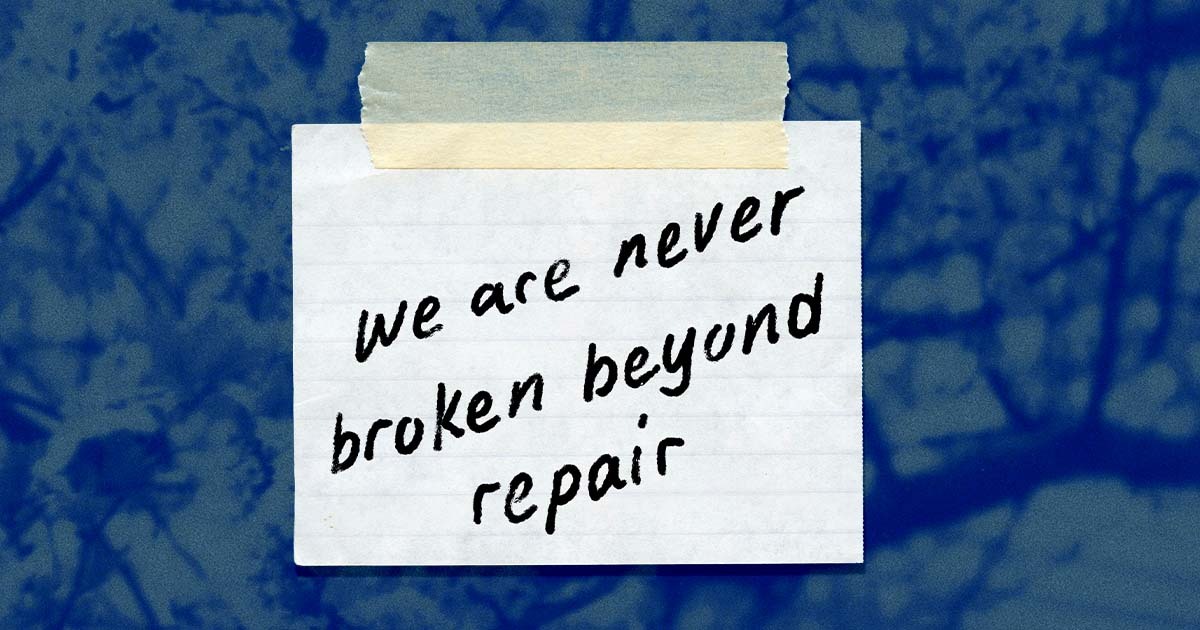
Even though we may think otherwise, we are never broken beyond repair. We can be made whole again, with our scars on full display, bearing witness to both crisis and cure. And in an indirect way of saying so, we become something unique and beautiful.
People need other people. You are not weak for wanting or needing support. If you’re seeking professional help, we encourage you to use TWLOHA’s FIND HELP Tool. If you reside outside of the US, please browse our growing International Resources database. You can also text TWLOHA to 741741 to be connected for free, 24/7 to a trained Crisis Text Line counselor. If it’s encouragement or a listening ear that you need, email our team at [email protected].